
The Congo Square Algorithm: How African Polyrhythms and European Folk Forged America’s Billion-Dollar Sound

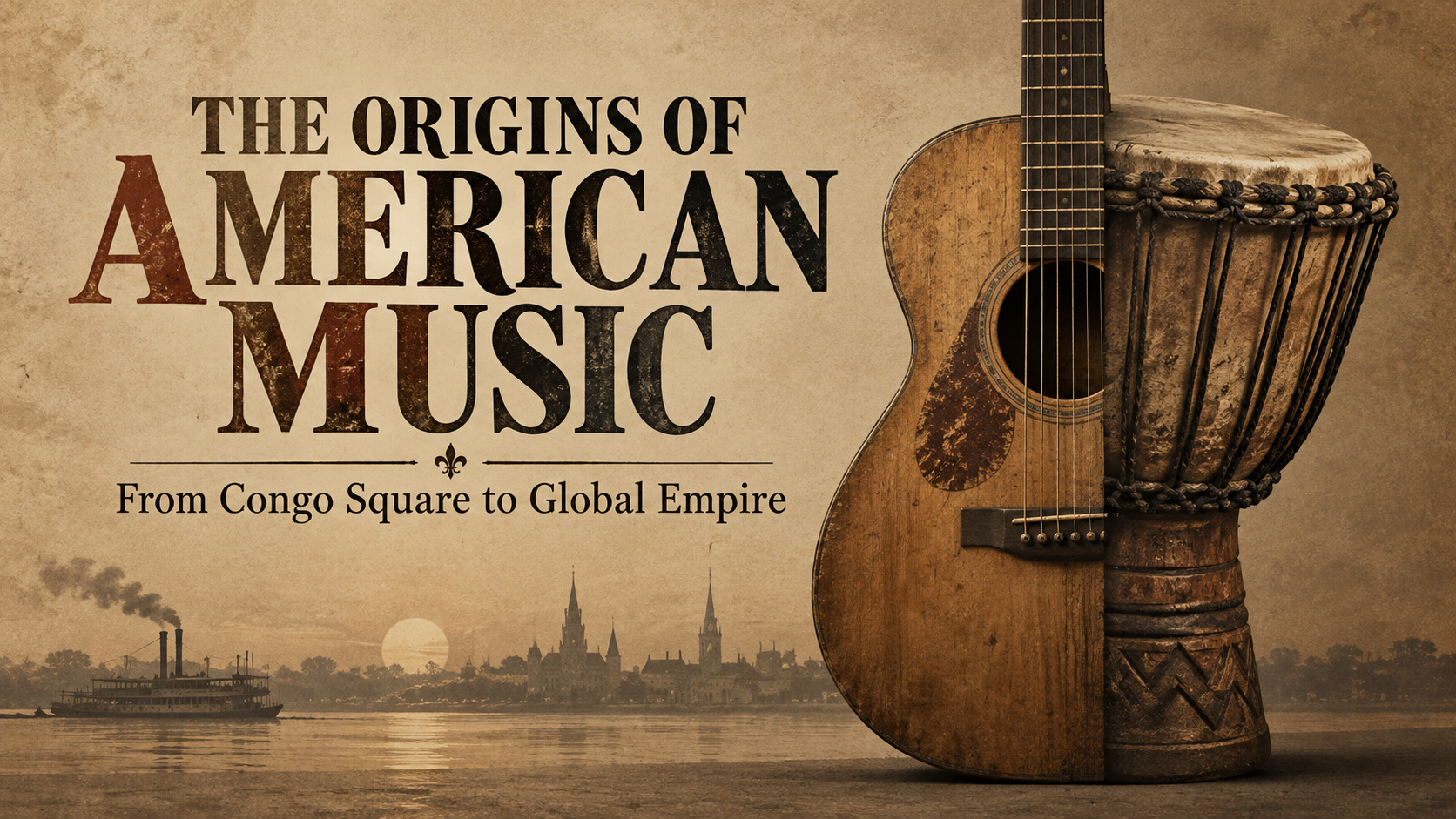
In the early 19th century, on a dusty plot of land in New Orleans known as Congo Square, enslaved Africans were granted a rare, temporary freedom on Sundays to play their traditional drums. And at the exact same time, deep in the Appalachian mountains, Scots-Irish immigrants were playing rigid, centuries-old European fiddle ballads.
For generations, sociologists assumed these two isolated, marginalized worlds would remain strictly separate, but they eventually collided along the Mississippi River to create the most dominant cultural export in human history. Therefore, to understand the DNA of modern global entertainment, audience strategists must study the exact historical characteristics that made American music an unstoppable phenomenon.
The history of American music is the ultimate case study in breaking the rules of traditional production. Before the 20th century, the European music industry relied on a top-down model: complex classical compositions, strictly written sheet music, and rigid harmonic structures.
However, the defining characteristic of early American music—born from the pain of the Delta Blues and the spirituals of the Deep South—was entirely oral and improvisational. It introduced the “call-and-response” structure and the “blue notes” (flattened thirds and sevenths) that European scales simply did not have. This wasn’t just a new sound; it was a flexible, open-source framework built for survival.
When we map the historical data of the 1920s, the turning point becomes strikingly clear. The American music industry industrialized this cultural fusion through events like the famous 1927 Bristol Sessions—often called the “Big Bang of Country Music.”
Producers recorded the raw, emotional storytelling of hillbilly folk alongside the rhythmic syncopation of the blues. By standardizing the 12-bar blues progression and the 4/4 time signature, American music created a universal, highly scalable “API.” Unlike a 40-minute classical symphony, a 3-minute Jazz or Rock ‘n’ Roll record could fit perfectly onto a 78-rpm vinyl disc and be broadcasted seamlessly over commercial radio.
The climax of this historical evolution was the birth of Rock ‘n’ Roll and R&B in the 1950s. The raw, syncopated rhythms of Black artists were merged with the mass-market distribution machine of American capitalism.
The ripple effect was global domination. American music did not conquer the world because it was sophisticated; it conquered the world because its characteristics—improvisation, heavy rhythmic beats, and relatable emotional storytelling—bypassed language barriers and plugged directly into human neurology.
The fundamental characteristic of American music is its endless capacity for assimilation and reinvention. It is a melting pot that turns cultural friction into scalable value.
Modern content creators are constantly trying to invent new frameworks, but they are ignoring the greatest historical blueprint we have. If you are targeting highly lucrative audiences in the US, UK, or Canada today, you must study this history: strip away the rigid, over-produced corporate templates and inject the raw, “call-and-response” emotional authenticity of early American Blues and Jazz into your digital campaigns right now.
Lora Music – Music for Life